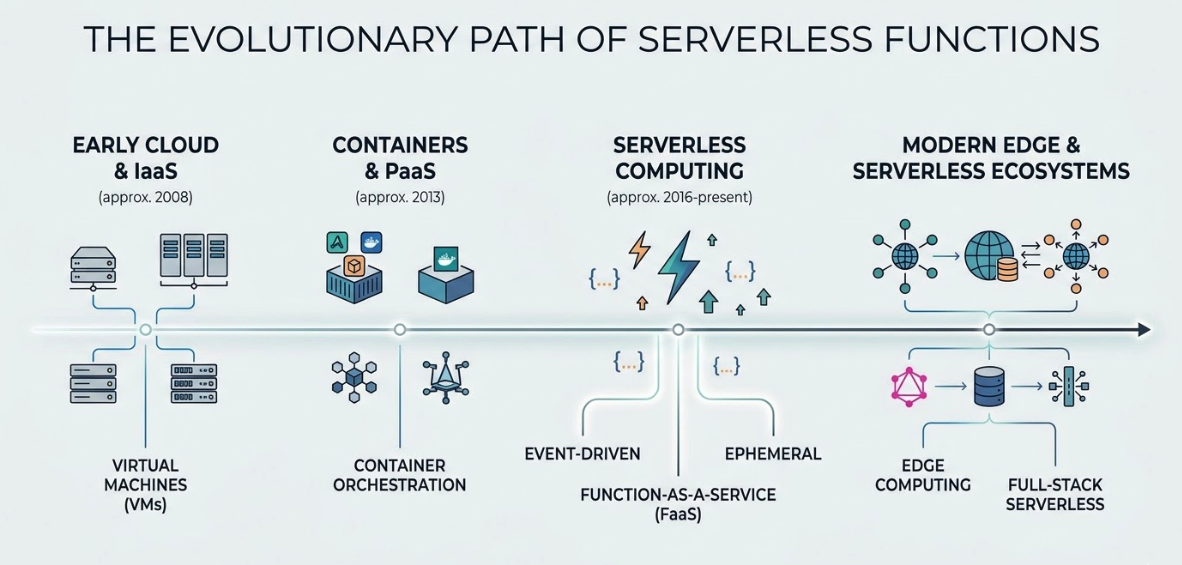
When AWS Lambda launched in 2014, serverless functions were simple event handlers. You uploaded a function, triggered it with an API Gateway event, and paid only for the compute time used. A decade later, the serverless model has evolved into something far more capable — and complex. This article traces that evolution and examines where serverless is heading.
The First Generation: Stateless Event Handlers
Early serverless functions were designed for one job: handle a single event and return a response. They were stateless by design — each invocation started fresh with no memory of previous calls. This model worked well for webhooks, image resizing, simple CRUD APIs, and cron-like scheduled tasks.
The constraints were significant. Cold starts added 500ms to 5 seconds of latency depending on the runtime. Execution was capped at 15 minutes. Functions could not maintain persistent connections to databases, which led to connection pool exhaustion under load. Despite these limitations, the pay-per-invocation model was so compelling that adoption grew rapidly, especially for low-traffic APIs and event-driven microservices.
The Second Generation: Improved Performance and Tooling
Cloud providers invested heavily in reducing cold start latency. AWS introduced Provisioned Concurrency, which keeps function instances warm and ready. Cloudflare Workers took a different approach by running functions on V8 isolates instead of containers, achieving cold starts under 5 milliseconds. Deno Deploy and Vercel Edge Functions followed a similar model.
Database connectivity improved with services like AWS RDS Proxy and Neon's serverless PostgreSQL driver, which manage connection pooling at the infrastructure level rather than inside the function. Frameworks like the Serverless Framework, SST, and AWS SAM made deployment and configuration manageable, replacing long CloudFormation templates with concise infrastructure-as-code definitions.
This generation made serverless viable for production workloads that required low latency and high throughput. Teams began using serverless for their entire API layer, not just edge cases and background jobs.
The Third Generation: Stateful Serverless
The most significant recent evolution is the emergence of stateful serverless platforms. Azure Durable Functions introduced the concept of orchestrator functions that can maintain state across multiple steps, handle retries, and manage long-running workflows. AWS Step Functions provides similar capabilities through a state machine model.
These platforms allow you to build complex business processes — order fulfillment, document processing pipelines, multi-step approval workflows — entirely in serverless without managing background workers, state databases, or queue infrastructure. The platform tracks where each execution is in its workflow and resumes it after each step completes.
More recently, platforms like Cloudflare's Durable Objects and Temporal (which is open-source) have pushed this further by providing per-entity state that persists across function invocations. This enables real-time collaborative features, game state management, and shopping cart persistence — use cases that were previously impossible without traditional servers.
When Serverless Is the Wrong Choice
Serverless is not universally better. Workloads that run continuously — background processing jobs, WebSocket servers, ML inference — are cheaper and simpler to run on containers or VMs. The per-invocation pricing model becomes expensive at high volumes, and the execution time limits constrain long-running tasks.
Debugging and observability remain harder with serverless. Distributed tracing across dozens of functions requires careful instrumentation, and local development environments do not perfectly replicate the cloud runtime. Vendor lock-in is also a consideration since each platform's function runtime, event triggers, and state management APIs are proprietary.
The sweet spot for serverless in 2026 is variable-traffic APIs, event-driven processing, and multi-step workflows. For these use cases, no other architecture matches the combination of operational simplicity, automatic scaling, and cost efficiency that serverless provides.